Lesson
Digestive System and Feeding Habits
Alimentary Tracts
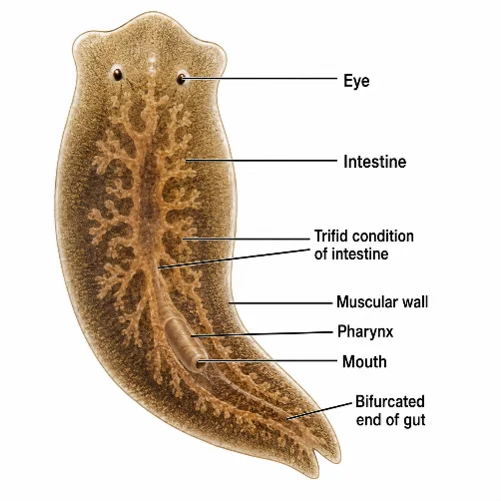
Food is taken into the alimentary tract or canal, gut or gastro-intestinal tract, for digestive purposes. For the purpose of taking in food into various tracts, teeth, tentac1es, claws and structures are used, depending on whether the organisms involved are vertebrates or invertebrates. The alimentary tracts for invertebrates can be understood through studying of Planaria (a platyhelminth), an earthworm (annelid) and grasshopper or cockroach (an insect).
For the tracts of vertebrates, birds, rabbit and man can be studied.
For Planaria the parts are mouth, pharynx, intestine and caecum.
The earthworm and cockroach/ grasshopper each possesses mouth, pharynx, gullet, crop, intestine, caecum, rectum and anus.
The bird and these two groups of invertebrates have no teeth in their mouths. Their stomachs are modified into Gizzards whose stone contents help to masticate food. Rabbit and man each has mouth, pharynx, gullet, stomach, intestine, caecum, rectum and anus. Recall that in theory the stomach of ruminants (animals that chew the curd), such as goat, cow, sheep are subdivided through modification into rumen, reticulum, psalterium and abomasum.
Study the figures below and discuss the ways the named structures and their modified forms perform the digestive functions.